The general population frequently experiences pain in the lumbar region of the spine, with a reported prevalence ranging from 31 % to 64 % (Tunås et al. 2015). Nonspecific low back pain, or chronic low back pain, is characterized by pain with no known specific cause and is the most common form of back pain (Bahr et al. 2004).
Osteopathic treatment for lower back pain is one of the effective solutions used to manage such problems.
Pain in the lumbar spine can significantly impact people's lives. It negatively affects their psychological well-being, reduces motivation, and increases stress and anxiety, while also lowering the quality of life and, in some cases, leading to early retirement (Noormohammadpour et al., 2016).
Risk factors for lower back pain include poor muscle strength and endurance, poor flexibility, poor posture, previous injuries, high stress levels, and anxiety. Age, gender, and body mass index (BMI) also have an impact on it (Hübscher et al., 2010).
Additionally, visceral issues such as constipation, irritable bowel syndrome, gastrointestinal bloating, and bladder or pelvic floor muscle problems can cause lower back pain (Villalta Santos et al. 2019).
Treatment options
Current treatment options for lower back pain often include physical therapy, medication, and surgery. Physiotherapy Maribor is an example where local experts offer solutions to patients with back pain. The most common approaches involve the use of manual techniques, exercises, and physical agents such as: TECAR therapy, high-intensity laser therapy (HILT), focused shockwave therapy, and magnetic field therapy. The combination of physical therapy and osteopathic treatment for lower back pain can yield even better results for patients.
These techniques aim to reduce inflammation and pain, increase mobility, and improve the function of affected areas (Israel 2012). Manual therapy has proven to be one of the most commonly used methods in recent years. It achieves a high rate of recovery while also being cost-effective (Hainline et al. 2017).
Book your check-up
Our method combines modern techniques and proven methods to ensure a comprehensive approach and long-lasting results.
Don't wait any longer! Book your appointment today and take the first step toward better health.
Osteopathy is based on the belief that the body is a single entity and that disturbances in one part of the body can be connected to other body systems. The osteopathic approach is based on the principle that the body can heal itself and that its structure and function are interrelated (McSweeney et al. 2012).
Recently, general interest in osteopathy has been growing, especially in Slovenia. Among other things, researchers have proven a connection between non-specific low back pain and visceral functional or structural issues, such as urinary incontinence, chronic bladder inflammation, polycystic ovaries, breathing disorders, abdominal scars, and gastrointestinal disorders (Bertuit et al., 2021).
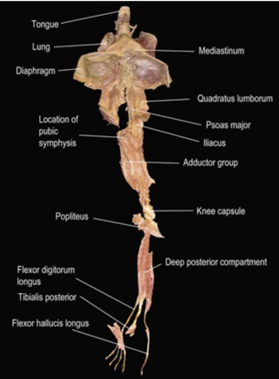
Deep anterior fascial line
These connections can be explained by both mechanical and neurological mechanisms. Functional problems of internal organs after surgery or inflammation can cause adhesions, which can affect the mobility of visceral connective tissue, such as fascia. These affect the movement of neighboring somatic tissues or tissues with corresponding spinal innervation (Cervero 2000). The altered elasticity of the fascia negatively affects its ability to absorb forces and provide stability and support.
Mechanical stress due to poor posture or inflammation can alter fascia at the cellular level, which can disrupt spinal biomechanics and cause myofascial pain. In addition, reduced fascial sliding decreases blood and lymph flow, which can hinder the removal of inflammatory substances. The resulting decrease in pH in soft tissues can provoke increased sensitivity of pain receptors to mechanical stimuli, which can cause or worsen pain (Panagopoulos et al. 2013).
The abdominal and pelvic organs are connected to the lumbar spine via connective tissues such as the abdominal mesentery and mesocolon. These connective tissues contain blood vessels, nerves, and lymphatic vessels, and can influence the mobility of somatic tissue near the organs in the area of the corresponding spinal innervation.
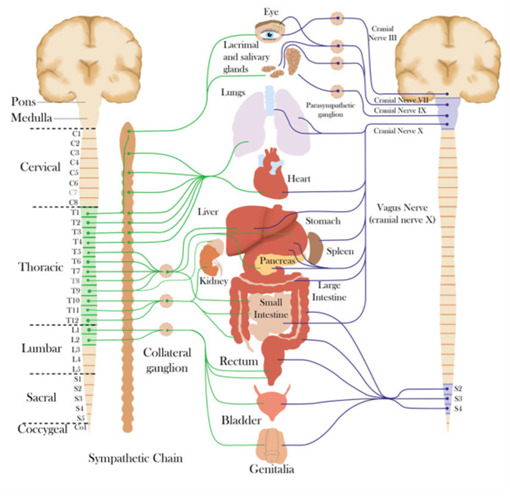
This states that the condition of the abdominal and pelvic organs can affect distant body segments via the sympathetic nervous system (Villalta Santos et al. 2019).
Sympathetic nerves, which provide information about internal organs, merge with somatic nerves in the dorsal part of the spinal cord. This convergence can lead to confusion in pain perception, as conscious sensation may be perceived from somatic structures instead of visceral structures, which is known as referred pain.
This mechanism is the best understood way in which altered organ relationships can contribute to a condition such as non-specific low back pain (Panagopoulos et al. 2015).
Innervation of organs by the sympathetic and parasympathetic branches of the autonomic nervous system
When treating a patient, ‘authentic’ osteopathic manipulative treatment (OMT) is used, in which practitioners are recognized as osteopaths or osteopathic physicians and have the option to choose manual techniques. The osteopat determines independently which form of treatment is most appropriate for the individual patient, without the requirement of following standardized treatment protocols. Osteopathic treatment for low back pain allows for the adaptation of each treatment method to the specific needs of the individual, which best represents the practice of osteopathy in the real world.
McSweeney et al. (2012) demonstrated that the application of visceral techniques in healthy individuals increases the pain threshold in related vertebral segments, indicating that visceral manual therapy can immediately induce hypoalgesia in somatic structures that are segmentally connected to the mobilized organ.
Accordingly, Dal Farra et al. (2021) and Licciardone et al. (2016) found that various osteopathic techniques, including spinal mobilization and local soft tissue techniques, effectively reduce pain and improve function in individuals with chronic and acute lower back pain. These results highlight the potential benefits of osteopathic treatment in managing pain and functional issues associated with lower back pain.
Ferreira et al. (2013) found that a combination of physical therapy and osteopathic treatment is more effective at reducing pain and improving function in individuals with nonspecific low back pain than physical therapy alone. The study showed that the group that received the combined treatment achieved greater improvement in pain scores, mobility, and quality of life than the group that received physical therapy alone.
These studies show that both osteopathic treatment and physiotherapy can effectively treat non-specific low back pain, and that a combination of both treatments can offer even better results for patients.
Bahr, R., Andersen, S. O., Løken, S., Fossan, B., Hansen, T. and Holme, I. (2004) ‘Low back pain among endurance athletes with and without specific back loading–a cross-sectional survey of cross-country skiers, rowers, orienteerers, and nonathletic controls’, Spine, 29(4), pp. 449–454. doi: 10.1097/01.brs.0000096176.92881.37
Bertuit, J., Bakker, E. and Rejano-Campo, M. (2021) ‘Relationship between urinary incontinence and back or pelvic girdle pain: a systematic review with meta-analysis’, International Urogynecology Journal, 32(5), pp. 1073–1086. doi: 10.1007/s00192-020-04670-1
Cervero, F. (2000) ‘Visceral pain-central sensitisation’, Good, 47 Suppl 4(4), pp. 56-58. doi: 10.1136/gut.47.suppl_4.iv56
Dal Farra, F., Risio, G. H., Vismara, L. and Bergna, A. (2021) ‘Effectiveness of osteopathic interventions in chronic non-specific low back pain: A systematic review and meta-analysis’, Complementary Therapies in Medicine, 56, p. 102616. doi: 10.1016/j.ctim.2020.102616
Degenhardt, B.F. and Kuchera, M.L. (2006) ‘Osteopathic evaluation and manipulative treatment in reducing the morbidity of otitis media: a pilot study’, The Journal of the American Osteopathic Association, 106(6), pp. 327–334.
Ferreira, P.H., Ferreira, M. L., Maher, C. G., Refshauge, K. M., Latimer, J. and Adams, R. D. (2013) ‘The therapeutic alliance between clinicians and patients predicts outcome in chronic low back pain’, Physical Therapy, 93(4), pp. 470–478. doi: 10.2522/ptj.20120137
Franke H, Franke JD, Fryer G. (2014) ‘Osteopathic manipulative treatment for nonspecific low back pain: a systematic review and meta-analysis’, BMC Musculoskeletal Disorders, 15, pp. 286. doi: 10.1186/1471-2474-15-286
Hainline, B., Turner, J. A., Caneiro, J. P., Stewart, M. and Lorimer Moseley, G. (2017) ‘Pain in elite athletes-neurophysiological, biomechanical and psychosocial considerations: a narrative review’, British Journal of Sports Medicine, 51(17), pp. 1259–1264. doi: 10.1136/bjsports-2017-097890
Hübscher, M., Zech, A., Pfeifer, K., Hänsel, F., Vogt, L. and Banzer, W. (2010) ‘Neuromuscular training for sports injury prevention: a systematic review’, Medicine and Science in Sports and Exercise, 42(3). doi: 10.1249/MSS.0b013e3181b88d37
Izraelski, J. (2012) ‘Assessment and Treatment of Muscle Imbalance: The Janda Approach’, The Journal of the Canadian Chiropractic Association, 56(2), p. 158.
Licciardone, J. C., Gatchel, R. J. and Aryal, S. (2016) ‘Recovery From Chronic Low Back Pain After Osteopathic Manipulative Treatment: A Randomized Controlled Trial’, The Journal of the American Osteopathic Association, 116(3), pp. 144–155. doi: 10.7556/jaoa.2016.031
McSweeney, T. P., Thomson, O. P. and Johnston, R. (2012) ‘The immediate effects of sigmoid colon manipulation on pressure pain thresholds in the lumbar spine’, Journal of Bodywork and Movement Therapies, 16(4), pp. 416–423. doi: 10.1016/j.jbmt.2012.02.004
Noormohammadpour, P., Rostami, M., Mansournia, M. A., Farahbakhsh, F., Pourgharib Shahi, M. and Kordi, R. (2016) ‘Low back pain status of female university students in relation to different sport activities’, European Spine Journal: Official Publication of the European Spine Society, the European Spinal Deformity Society, and the European Section of the Cervical Spine Research Society, 25(4), pp. 1196–1203. doi: 10.1007/s00586-015-4034-7
Panagopoulos, J., Hancock, M. and Ferreira, P. (2013) ‘Does the addition of visceral manipulation improve outcomes for patients with low back pain? Rationale and study protocol’, Journal of Bodywork and Movement Therapies, 17(3), pp. 339–343. doi: 10.1016/j.jbmt.2012.12.004
Panagopoulos, J., Hancock, M., Ferreira, P., Hush, J. and Petocz, P. (2015) ‘Does the addition of visceral manipulation alter outcomes for patients with low back pain? A randomized placebo controlled trial’, European Journal of Pain (London, England), 19(7), pp. 899–907. doi: 10.1002/ejp.614
Tunås, P., Nilstad, A. and Myklebust, G. (2015) ‘Low back pain in female elite football and handball players compared with an active control group’, Knee surgery, sports traumatology, arthroscopy: official journal of the ESSKA, 23(9), pp. 2540–2547. doi: 10.1007/s00167-014-3069-3
Villalta Santos, L., Lisboa Córdoba, L., Benite Palma Lopes, J., Santos Oliveira, C., André Collange Grecco, L., Bovi Nunes Andrade, A. C. and Pasin Neto, H. (2019) ‘Active Visceral Manipulation Associated With Conventional Physiotherapy in People With Chronic Low Back Pain and Visceral Dysfunction: A Preliminary, Randomized, Controlled, Double-Blind Clinical Trial’, Journal of Chiropractic Medicine, 18(2), pp. 79–89. doi: 10.1016/j.jcm.2018.11.005
Almedin Muharemović
With 10+ years of experience and rich expertise, I am changing people's lives for the better.